
 I am a big fan of fall — the start of school, K-State football games, pumpkin spice lattes, to name just a few of my favorite things! This fall marks the seventh year of the Institute for the Health and Security of Military Families, which launched on Oct. 2, 2009. I was pregnant with my second child, so it also reminds me how quickly time flies!
 In this annual newsletter, I provide an overview of the major events that occurred during the past year and an update on what is to come. In the fall 2015 semester, we had our annual K-State Season of Service, which involved military-related events at the university. Two of our events were lectures by nationally known individuals, Wes Moore and Francis Gary Powers Jr. If you saw the movie, “Bridge of Spies” with Tom Hanks, then you know the story of the U-2 incident involving Powers’ father.
 We have added some new projects and partners in the past year. In August 2015, the institute and our Invisible Wound Alliance partners received preliminary funding from the Walter Reed Society to conduct four of our integrative, community-based retreats for service members/veterans and their primary support persons. We have conducted three of the four retreats in Washington, D.C., Chicago, Illinois, and Manhattan, Kansas. The institute has served as the primary research lead for these retreats, and we submitted our first manuscript for publication with data from our first seven retreats. Our preliminary research indicates a reduction in post-traumatic stress disorder symptoms in both veterans and their support persons, and improved couple relationship functioning in both veterans and spouses. Read more about our unique retreat model in an article in this newsletter.
We also added a new annual event, the Military Spouse Appreciation Day Luncheon. More than 75 K-State and community military spouses attended the event, which included a guest speaker and recognition of two military/veteran spouses who demonstrate resilience.
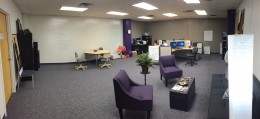
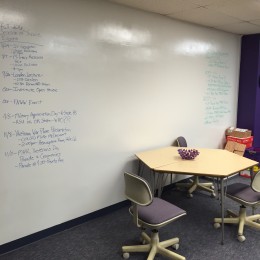
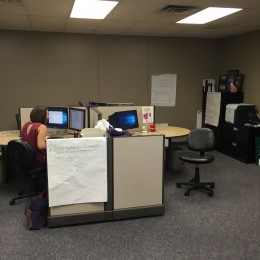 The end of summer brought some exciting progress for the institute and recognition of our work. We received some space in our on-campus building to house the institute for at least the next year. We have been working for more than 18 months to obtain space to house our ever-growing programs and personnel. Running the institute out of my office had become less than ideal. Enclosed are some pictures of our new space and work areas for our outreach programs, research projects and personnel, including graduate and our army — literally — of undergraduate interns and students.
Last but definitely not least, I was honored in September by the chief of staff of the U.S. Army, Gen. Mark Milley. I was one of four recipients of the Outstanding Civilian Service Award at the Salute from the Chief and Twilight Tattoo in September. To say that this is exciting is an understatement — I’m not sure it has quite sunk in yet!
As you can see, the institute continues to work to support our service members, veterans and military families through our work. Stop by the new office in 245 Justin Hall anytime to see our team in action!

Briana S. Nelson Goff, PhD
Professor, School of Family Studies and Human Services
Director, Institute for the Health and Security of Military Families
militaryfamilies.k-state.edu
1324 Lovers Lane
343K Justin Hall
Kansas State University
 Author, decorated combat veteran and Rhodes scholar Wes Moore spoke Wednesday, Oct. 14, 2015, about the intentions and motives of his book, “The Other Wes Moore.” McCain Auditorium was filled with students, staff and faculty as Moore shared personal stories and motivated the crowd to see their higher education in a new way.
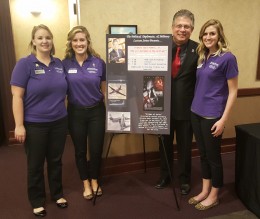 Francis Gary Powers Jr., son of Francis Gary Powers, a U.S. Air Force pilot who was shot down over the Soviet Union in 1960, presented the lecture “The U-2 Incident and the Cold War” on Wednesday, Oct. 21, 2015, at the K-State Alumni Center. About 175 people attended, including members of the university and Fort Riley communities, as well as surrounding communities. In 2003, Powers Jr. wrote a book about the U-2 incident, “Operation Overflight: A Memoir of the U-2 Incident.” In addition to the lecture, the event included a book sale and signing beforehand, and a meet-and-greet and reception afterward.
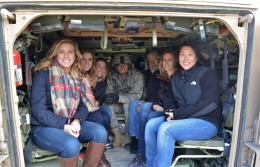 Fort Riley’s 1st Engineering Battalion hosted a Gunnery Partner/Family Day on Wednesday, Nov. 18, 2015. Invited to the event were community partners and military spouses and family members. The institute’s interns, Brittany Beneke and Emily Betthauser, attended the event. Community partners and family members were taken to a tower to overlook, observe and listen to crews going through their runs on the range in their Bradley Fighting Vehicles. Afterward, Beneke and Betthauser were able to sit in on an After Action Review, or AAR, where trainers evaluated the crews on how they performed during their run on the range.
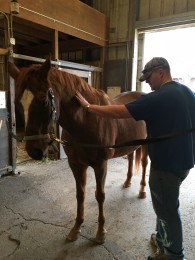 As our military troops are deployed into war zones and unsettled areas, more soldiers are returning home and facing the challenges that occur with post-traumatic stress disorder. To improve the well-being of military families, Briana Nelson Goff, director of the Institute for the Health and Security of Military Families, has partnered with a team that offers retreats for post-9/11 service members and veterans dealing with PTSD. The institute and the team, known as the Invisible Wound Alliance, have developed, organized and hosted regional retreats for veterans and primary support persons, who attend the retreats with the veterans. In 2015, the institute and the alliance received funding from the Walter Reed Society, which has allowed them to expand the program. These retreats are titled “Bridging the Gap” because of the chasm that can open up between soldiers returning from deployments and their loved ones and communities. The Invisible Wound Alliance has been involved with developing the retreats program since 2011. The first Bridging the Gap retreat funded by the Walter Reed Society was in Washington, D.C., in December 2015, with a second in Chicago, Illinois, in March 2016, and a third in Manhattan, Kansas, in August 2016. The Walter Reed Society funding has allowed the program to rotate the areas where the retreats are organized to be accessible to veterans all over the nation.
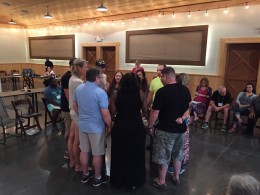 For each retreat, 10-12 pairs are selected, with veterans choosing the support person — spouse, sibling, parent or friend — to attend with them. During the retreats, participants receive psychological education about PTSD and are introduced to a variety of coping methods, such as yoga, art therapy, meditation, equine and canine therapies, and other complementary and alternative modalities. The institute provides the research and evaluation program for the retreats, conducting data collection on 10 retreats since 2013 and expanding to include biometric indicators of stress in the participants in 2016.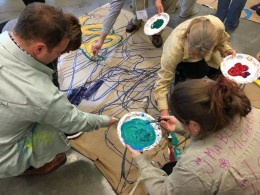
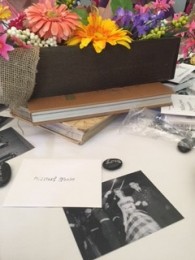 K-State students and military spouses gathered for a luncheon May 6 at the Marianna Kistler Beach Museum of Art on K-State’s Manhattan campus in honor of Military Spouse Appreciation Day. Speaking at the luncheon was Sharon Gerdes, College of Human Ecology alumna, author and former military spouse. The institute also recognized two recipients of the inaugural Military Spouse Resilience Award: Sara Devine (pictured right) and Carolyn Toliver-Lee (pictured left).
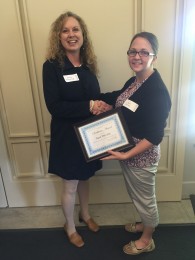 Devine is a K-State graduate with bachelor’s degrees in geography and secondary social studies education. This fall, she became a special education teacher in Junction City, Kansas, and started working on her master’s in special education at K-State. Devine is a constant support to her husband, who was diagnosed with post-traumatic stress disorder, anxiety and insomnia after his war deployment.
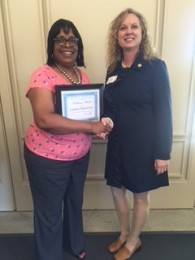 Toliver-Lee is a family advocacy program specialist at Fort Riley, Kansas, and has master’s degrees from K-State and Northcentral University. Toliver-Lee has a conflict resolution certificate from K-State and works with the Child Abuse Prevention Campaign. Her husband sustained a traumatic brain injury and was medically and honorably discharged from the military. In 2004, he sustained another severe closed traumatic brain injury, which left him temporarily blind and paralyzed. He currently receives full-time care from the U.S. Department of Veterans Affairs in Topeka, Kansas, and the support, love and encouragement of his wife and sons.