The Rapid Response Center was formed in 1995 as a resource for Kansas State University Research & Extension Agents. Resource topics included Food Science, Human Nutrition, Food Service, Textiles, Home Care and other consumer topics. Since that time, the Center has grown to be of valuable assistance to Kansas State University Extension Specialists in those areas.
As the weather warms up, plans are being made for local fairs to exhibit many foods and food preservation items.
A three-part series is available on how to judge food and food preservation exhibits at fairs. If you have been a judge or are new to judging, please review all materials so you are up-to-date.
All recordings and information can be found on the Rapid Response Center—Judging at Fairs website. Please contact your local Extension office for more information.
We thank you for being a judge at fairs! This is your opportunity to educate exhibitors and share your knowledge.
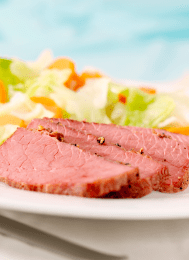
To start, what does the term “corning” mean? It is a form of dry-curing beef brisket with “corns” of salt. These corns are not actual corn, but refer to the size of the salt crystals. Originally, this was a way to preserve beef during the winter months and through the season of Lent.
Today, corned beef can be found throughout the year. It is traditionally served with cabbage on St. Patrick’s Day but also as tasty meat for sandwiches.
You can buy corned beef that is ready to cook. It is in a salt brine with spices. Use a long, moist cooking method either in the oven, on top of the stove or a slow cooker. It should be “fork-tender” with an internal temperature of 160°F. It will likely have a pink color after cooking because of the nitrites used in the curing process. Cut into slices against the grain.
As announced on January 15, 2025, the Food and Drug Administration is banning the use of FD&C Red No. 3 in any food product or drugs that are ingested. What foods does this affect? Any food or ingested drug that has a bright, cherry-red color. Food examples include candy, cakes and cupcakes, cookies, frozen desserts, and frosting or icings.
Two studies have shown cancer in laboratory male rats when exposed to high levels of FD&C Red No. 3 due to a rat specific hormonal mechanism. There are no scientific studies that have shown the relationship of consuming FD&C No. 3 causing cancer in humans or other animals. According to the Delaney Clause, if any food additive or color additive is proven to induce cancer in humans or animals, it cannot be used.
Manufacturers using FD&C Red No. 3 must reformulate their products by January 15, 2027 or January 18, 2028 based on sales. Imported foods into the U.S. must comply with FDA regulations and not contain this ingredient. Examples of colors to replace FD&C Red No. 3 may include red beet extract or paprika extract.
Besides the flu, COVID, and RSV illnesses occurring this time of year, there has been an increase in Norovirus across the country. The typical peak season is December to March.
Norovirus is very contagious and causes vomiting and diarrhea. Some may call it the “stomach flu” or “stomach bug.” But it is not related to the flu. It is the leading cause of vomiting and diarrhea, and foodborne illness. People of all ages can get infected. Norovirus causes about half of the all outbreaks of food-related illness.
One of the simplest prevention measures is proper and frequent handwashing. Clean and disinfect contaminated surfaces. Wash laundry in hot water if possible. Stay home to prevent the spread to others. Most people will recover in 1 to 3 days. There is no medication to treat Norovirus.
Be sure to drink plenty of liquids to reduce dehydration. If dehydration becomes severe, seek medical care.
The Food and Drug Administration has proposed a new addition to food products by adding nutrition information on the front of packages. The goal is to give consumers “at-a-glance” information when choosing foods. It will only give information for saturated fat, sodium, and added sugar. It will also show the amounts as high, medium or low in value.
Current federal dietary recommendations advise U.S. consumers to limit these three nutrients to achieve a nutrient-dense diet within calorie limits. This proposal is currently in the comment phase to get more information from contributors.
Six locations will be host workshops for local foods entrepreneurs to learn about food safety, business practices, sales tax and more. This is a brought to you by K-State Research and Extension, Kansas Department of Agriculture, and the Kansas Center for Sustainable Agriculture and Alternative Crops.
North Dakota State University Extension is offering their popular webinar series entitled Field to Fork. The 2025 edition will be held on Wednesdays from February 12 to May 7 from 2-3pm CST.
These webinars are presented by NDSU faculty and other invited speakers from surrounding states. Topics are typically focused on gardening and preserving food.
Eggnog is a holiday party classic that dates back to the 13th century. This creamy, thick, spiced egg drink is a favorite for many worldwide.
Because eggnog uses eggs, there are ways to make it safely to prevent giving the gift of foodborne illness. And don’t let the added alcohol fool you! The alcohol will not kill bacteria.
Instead of using raw eggs, use pasteurized eggs. They have been commercially pasteurized with a low temperature heat treatment that destroys Salmonella without changing the physical and nutritional properties of the eggs. They are slightly higher in cost to standard eggs, but are worth the price to prevent foodborne illness. Egg substitutes are also an option.
Another, and even safer, method is to make a cooked egg base.
Combine eggs and half the milk. Sugar may be added also.
Cook the mixture to 160°F, stirring constantly. Use a double boiler to prevent scorching.
After cooking, pour into a bowl and place in the refrigerator to chill.
Add remaining ingredients and enjoy!
If buying prepared eggnog, read the label to be sure it is pasteurized.
Six locations will be host workshops for local foods entrepreneurs to learn about food safety, business practices, sales tax and more. This is a brought to you by K-State Research and Extension, Kansas Department of Agriculture, and the Kansas Center for Sustainable Agriculture and Alternative Crops.