Beef Tips

Category: January 2026

Managing Hay Quality for Cows

Justin Waggoner, KSU Extension Beef Cattle Specialist, Garden City, KS

Cattle operations typically produce or have access to several different types and qualities of hay. Strategically managing hay inventories requires an accurate assessment of the nutrient content of the forage(s) and a basic of understanding of cow nutrient requirements. Our objective is to match the forage resources to the nutrient demands of the cowherd and avoid under/over-supplying nutrients (i.e., energy and protein). Continue reading “Managing Hay Quality for Cows”
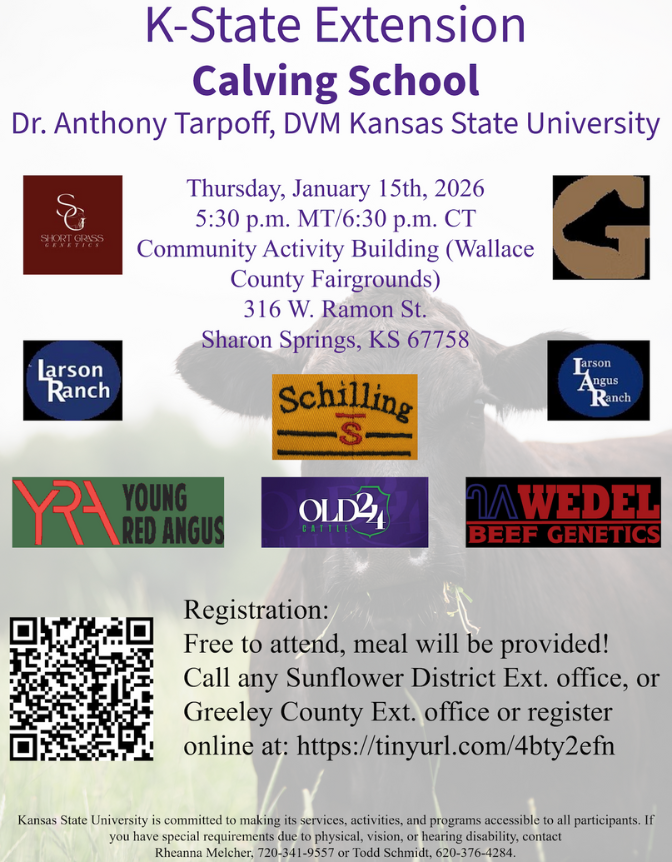
K-State to Host Calving Schools Across Kansas

MANHATTAN, Kan. – In anticipation of calving season, Kansas State University’s Department of Animal Sciences and Industry and Kansas State University Extension will host several calving schools in January.

The program will outline overall calving management, including the stages of the normal calving process and tips for handling difficult calving situations. Continue reading “K-State to Host Calving Schools Across Kansas”

Cost Considerations for Replacements

Sandy Johnson, extension beef specialist, Colby; Jason Warner, cow-calf specialist; Glynn Tonsor, livestock and meat marketing specialist

Improvements in production efficiency have enabled the beef industry to produce more beef with fewer cows. The reduction in the number of beef cows in the U.S. has been occurring since the 1970s.  Increased fed cattle harvest weights are part of the efficiency story. To date, consumer demand for beef has remained strong, and market prices for all classes of cattle have reached record highs. So, what considerations should producers have as they contemplate ownership options for beef cows and replacements in this market? How many heifer calves should they keep as replacements, or what can they afford to pay if they are purchasing replacements?  Continue reading “Cost Considerations for Replacements”

Kansas Cool-Season Forage Quality Results for 2025

The forage quality results of the 2025 Kansas Performance Tests for cool-season annual forage varieties are available online at https://www.agronomy.k-state.edu/outreach-and-services/crop-performance-tests/forages/hay-and-silage/. The results are summarized by location (Garden City, Hays, and Belleville). Several forage quality metrics were measured across a range of forage varieties of rye, triticale, and wheat. Forage yield results were made available earlier this year and can be found at the same link. Continue reading “Kansas Cool-Season Forage Quality Results for 2025”

A Winter Guide to Keeping Lice in Check

Cassandra Olds, extension livestock entomologist

Although most healthy cattle can manage lice burdens without intervention, some animals will develop heavy burdens which may require insecticide intervention. Lice populations are most active from December through to March with numbers naturally declining as we move into the warmer summer months. Continue reading “A Winter Guide to Keeping Lice in Check”

Recovering Feed Intakes in Feedlot Cattle

Logan Thompson, sustainable grazing systems

As we move into winter, the likelihood of severe weather events impacting our ability to keep cattle fed on time increases. Mud and variable weather patterns also cause cattle to change their eating behavior, with more erratic consumption occurring around storm events. Alternatively, simple equipment failure may occur, where feed deliveries may be delayed for a short time until the issue can be resolved. These feeding interruptions impact all meal fed cattle, but for cattle on more energy dense rations, such as finishing animals, it is crucial to manage this period appropriately or long term impacts on performance and health can occur. Continue reading “Recovering Feed Intakes in Feedlot Cattle”

Registration Now Open for Cattlemen’s Day 2026

The 113th Cattlemen’s Day will be hosted on Friday, March 6, 2026, at The Bilbrey Family Event Center (located directly next to the Stanley Stout Center) in Manhattan, KS. Registration will be $25 if registered by February 20, or $35 if registered on/after February 21 or at the door. Morning refreshments and lunch are included with registration. Continue reading “Registration Now Open for Cattlemen’s Day 2026”