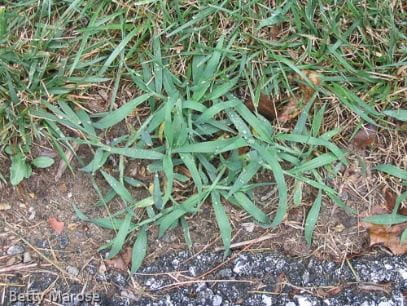
 Crabgrass preventers are another name for preemergence herbicides that prevent crabgrass seeds from developing into mature plants. Many people have a somewhat foggy idea of how they work and assume they kill the weed seed. Such is not the case. They do not kill the seed or even keep the seed from germinating but rather kill the young plant after it germinates. Therefore, they do not prevent germination but prevent emergence.
Crabgrass preventers are just that – preventers. With few exceptions they have no effect on existing crabgrass plants, so they must be applied before germination. Additionally, preventers do not last forever once applied to the soil. Microorganisms and natural processes begin to gradually break them down soon after they are applied. If some products are applied too early, they may have lost much of their strength by the time they are needed. Most crabgrass preventers are fairly ineffective after about 60 days, but there is considerable variation among products.
For most of Kansas, crabgrass typically begins to germinate around May 1 or a little later. April 15 is normally a good target date for applying preventer because it gives active ingredients time to evenly disperse in the soil before crabgrass germination starts. Even better, base timing on the bloom of ornamental plants. The Eastern Redbud tree is a good choice for this purpose. When the trees in your area approach full bloom, apply crabgrass preventer. A follow-up application will be needed about 8 weeks later unless you are using Dimension or Barricade. Products that do require a follow-up application include pendimethalin (Scotts Halts) and Team (Hi-Yield Crabgrass Control).
We recommend crabgrass preventers be applied before fertilizer so that the grass isn’t encouraged to put on too much growth too early. However, it may be difficult to find products that contain preemergents without fertilizer. Those that don’t contain fertilizer are listed below.
Barricade – Howard Johnson Crabgrass Control Plus with 0.37 Prodiamine 00-00-07
Pendimethalin – Scotts Halts
Team (Benefin + Trifluralin) – Hi-Yield Crabgrass Control
Dimension – Hi-Yield Turf & Ornamental Weed and Grass Stopper
By: Cassie Homan
 Chiggers are mites, not insects. And like all mites, the adults have eight legs. However, the larva only has six legs.
 Slime molds are common on turf and mulch and sometimes on tree trunks. Slime molds are not fungi and are no longer classified as such. They belong to the Kingdom Protista rather than Kingdom Fungi. On turf, you might see large numbers of small gray, white or purple fruiting structures, called sporangia on leaf blades during cool and humid weather throughout spring, summer, and fall. Affected areas are often several inches to 1 foot in diameter. During wet weather, the fruiting structures may appear slimy. As the structures dry out in hot weather, they become ash gray and break up easily when touched.
 Slime molds on mulch often attract attention because of their bright colors and disgusting appearance. Common names are often quite descriptive. For example, the “dog vomit” slime mold is a bright, whitish color that resembles its namesake. It eventually turns brown and then into a hard, white mass. Slime molds do not hurt anything, but most people do not find them attractive and want to get rid of them. Simply use a shovel to discard the offensive organism and then stir up the mulch for aeration.
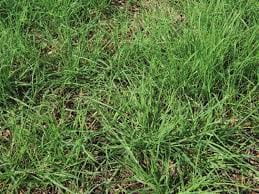
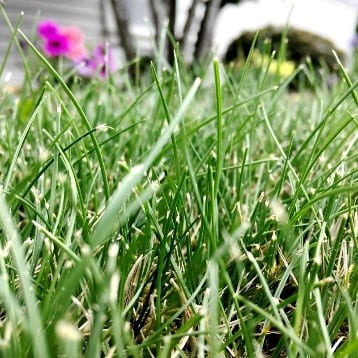
 The month of September signals the prime time to fertilize your tall fescue or Kentucky bluegrass lawns. If you could only fertilize your cool-season grasses once per year, this would be the best time to do it.
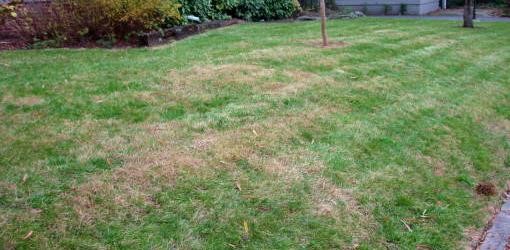 The recommendations differ for a lawn that was over watered or received so much rain this spring so that it produced a limited root system. Such a lawn may die unless allowed to slowly enter dormancy. This is done by shutting off the water gradually. For example, instead of watering several times a week, wait a week before irrigating. Then don’t water again for two weeks. Thereafter, water every two weeks as described below.